Updated for 2026 — This article has been reviewed and updated with the latest recommendations.
Knowing how fast a pitcher throws changes how you evaluate talent, structure practice, and track development. Whether you are a coach scouting travel ball games, a parent watching your kid progress, or a player measuring your own velocity gains, a radar gun gives you objective data that eyeballing speed never can.
training aids that develop throwing mechanics — The source focuses on measuring pitcher development; swing trainers and training aids are complementary tools for structured skill development..
Here are the 8 best baseball radar guns for 2026, covering everything from professional-grade units to affordable options that work great for recreational use.
Stalker Sport 2
The Stalker Sport 2 is the standard in professional baseball scouting.
MLB scouts and college recruiting coordinators carry these because the accuracy is within 0.1 mph and the readings are instantaneous. The continuous mode lets you track pitch speed from release point to the plate, giving you both peak and plate velocity in a single reading.
The unit picks up speeds from 5 to 150 mph and works at distances up to 300 feet. Battery life is excellent at around 30 hours on two AA batteries.
The build quality is tank-like, and most units last a decade or more with normal use. The price is steep, but if accuracy matters most, nothing beats it.
Price: $1,200-$1,500
Best for: Coaches, scouts, and programs that need professional-grade accuracy
Pocket Radar Ball Coach
The Ball Coach model from Pocket Radar fits in your hand and delivers accuracy within 1 mph of professional units.
At roughly 4 ounces, you can clip it to your belt and pull it out whenever you need a reading. The trigger-pull operation is simple enough that anyone can use it without reading a manual.
It reads speeds from 25 to 130 mph and works from behind the plate or from the side. Battery life is around 10,000 readings on two AAA batteries, which lasts an entire season for most users. The Ball Coach has become the default recommendation for travel ball coaches and serious baseball families.
Price: $300-$350
Best for: Travel ball coaches and families who want accuracy in a portable package
Pocket Radar Smart Coach
The Smart Coach adds Bluetooth connectivity to the Pocket Radar platform, letting you pair it with the free app on your phone or tablet. The app displays speed in large numbers visible from a distance and logs every reading automatically. You can review session data, track trends over time, and export reports.
Accuracy and range match the Ball Coach model.
The Bluetooth feature is particularly useful for pitchers working alone, since you can set up the radar on a tripod behind the plate and view readings on your phone from the mound. The hands-free tripod mode is a standout feature for solo training sessions.
Price: $400-$450
Best for: Players doing solo velocity training and coaches who want data tracking
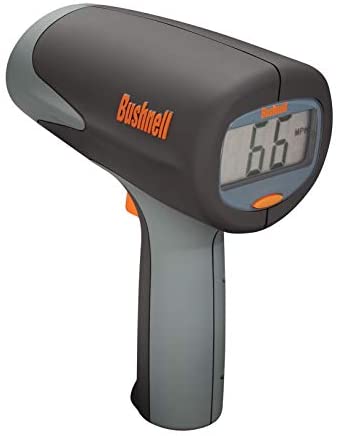
Bushnell Velocity Speed Gun
The Bushnell Velocity has been a popular budget radar gun for years, and it still delivers solid performance for recreational use.
The pistol-grip design is easy to point and shoot, and the digital readout is clear and readable. It picks up speeds from 10 to 110 mph at distances up to 90 feet.
Accuracy is within 2-3 mph of professional units, which is good enough for practice tracking and casual use. The shorter effective range means you need to be relatively close to the pitcher, which limits its usefulness at large field complexes.
But for backyard bullpen sessions and local league games, it works well.
Price: $100-$130
Best for: Recreational use and backyard practice
Rapsodo Pitching 2.0
The Rapsodo is not a traditional radar gun. It is a camera-based system that captures velocity, spin rate, spin axis, pitch movement, and strike zone location all in one device.
You set it up behind the catcher and it automatically records every pitch with video overlay showing all the metrics.
The data syncs to a cloud-based app where you can review sessions, compare pitches, and track development over time. College and professional pitching programs use Rapsodo extensively. The price puts it out of range for casual users, but for serious pitchers working on pitch development, the data is invaluable.
Price: $500-$600
Best for: Serious pitchers and programs focused on pitch development analytics
SKLZ Bullet Ball Speed Detection Training Ball
This is a completely different approach.
The Bullet Ball is a regulation-size baseball with a built-in speed sensor. You throw it like a normal ball and the LED display on the ball itself shows the speed after each throw. No separate device needed, no setup, no aiming.
Accuracy is within 2-3 mph and it measures speeds from 20 to 120 mph. The convenience factor is huge for young pitchers who want instant feedback during practice. The battery lasts around 2,000 throws.
The main limitation is that it only works for the person throwing the ball, so it cannot be used to measure hitters or opposing pitchers.
Price: $25-$35
Best for: Youth pitchers who want a fun, simple way to track velocity
Jugs Gun
Jugs has been making radar guns for baseball since the 1970s. Their current model maintains the company tradition of rugged reliability.
The pistol-grip design reads speeds from 10 to 150 mph and works at distances up to 300 feet. The large LCD display is easy to read even in bright sunlight.
Accuracy is within 0.5 mph, putting it close to professional-grade units. The build quality is heavy-duty and designed for daily use by coaches and programs. It runs on a 9-volt battery and lasts around 20 hours per battery. The Jugs Gun fills the gap between budget options and the premium Stalker units.
Price: $700-$900
Best for: Programs and coaches who want near-professional accuracy without the Stalker price
Pocket Radar Personal Speed Radar
The entry-level model from Pocket Radar delivers the same portable form factor as the Ball Coach but at a lower price. It reads speeds from 25 to 130 mph with accuracy within 2 mph. The unit fits in your pocket and weighs just 4 ounces.
It lacks the continuous mode and some advanced features of the Ball Coach, but for basic velocity readings, it performs well. The simple one-button operation makes it accessible for anyone.
If you want Pocket Radar quality without the full Ball Coach investment, this is the model to consider.
Price: $180-$220
Best for: Casual users who want Pocket Radar portability at a lower price
How to Choose a Baseball Radar Gun
Accuracy requirements drive the decision. If you are making roster decisions or tracking development for college recruiting, you need accuracy within 1 mph.
That means Pocket Radar Ball Coach at minimum, or Stalker Sport 2 for professional needs. For casual tracking and fun, 2-3 mph accuracy is fine.
Range matters for game use. If you want to measure speeds from the stands during games, you need 200+ feet of effective range. The Stalker and Jugs units handle this well. Pocket Radar works at moderate distances. Budget guns like the Bushnell need you much closer.
Portability vs.
features. Pocket Radar units go anywhere and require zero setup. Camera systems like Rapsodo give you vastly more data but need a specific setup behind home plate. Decide whether you want quick readings on the go or deep analytics at a fixed location.
Consider your budget honestly. The SKLZ Bullet Ball at $30 gives a young pitcher instant velocity feedback. The Pocket Radar Ball Coach at $350 gives a coach professional-quality readings.
Both serve their purpose well. Spending more than you need to does not make the data more useful.
Final Thoughts
The Pocket Radar Ball Coach is the best overall recommendation for most baseball families and coaches. It is accurate, portable, and lasts forever on a set of batteries. Scouts and professional evaluators should step up to the Stalker Sport 2. Young pitchers just looking to have fun tracking their speed will love the SKLZ Bullet Ball.
And coaches who want deep pitch analytics should consider the Rapsodo system for its unmatched data depth.