Updated for 2026 — This article has been reviewed and updated with the latest recommendations.
Practice makes permanent, not perfect. If you are grooving a bad swing in the cage, all you are doing is building muscle memory around flawed mechanics. The right training aids isolate specific parts of your swing and give you immediate feedback when something is off. That feedback loop is what turns average hitters into dangerous ones.
Here are the 8 best baseball training aids and swing trainers for 2026, each targeting a different aspect of hitting development.
Blast Motion Swing Analyzer
The Blast Motion sensor attaches to the knob of any bat and captures over 100 data points per swing.
It measures bat speed, hand speed, time to contact, attack angle, and vertical bat angle. All the data syncs wirelessly to the Blast app where you can review swings in real time, compare them side by side, and track progress over weeks and months.
The sensor weighs less than an ounce and does not affect the bat feel. It works with any standard bat including wood, composite, and aluminum. The app provides instant feedback and coaching cues based on your swing data.
College and professional hitters use Blast for daily swing monitoring.
Price: $100-$130
Best for: Data-driven players who want objective swing metrics
SKLZ Hit-A-Way Swing Trainer
The Hit-A-Way is one of the simplest and most effective swing trainers ever designed. A ball hangs from a rotating arm that mounts to a pole or fence post.
You swing and the ball orbits around, returning to the hitting zone for the next rep. No chasing balls, no feeding machine, no partner needed.
The constant repetition builds muscle memory and helps hitters develop consistent contact. The ball sits at a fixed height, so you can focus on level swings through the zone without worrying about pitch location. It sets up in minutes and folds down for storage.
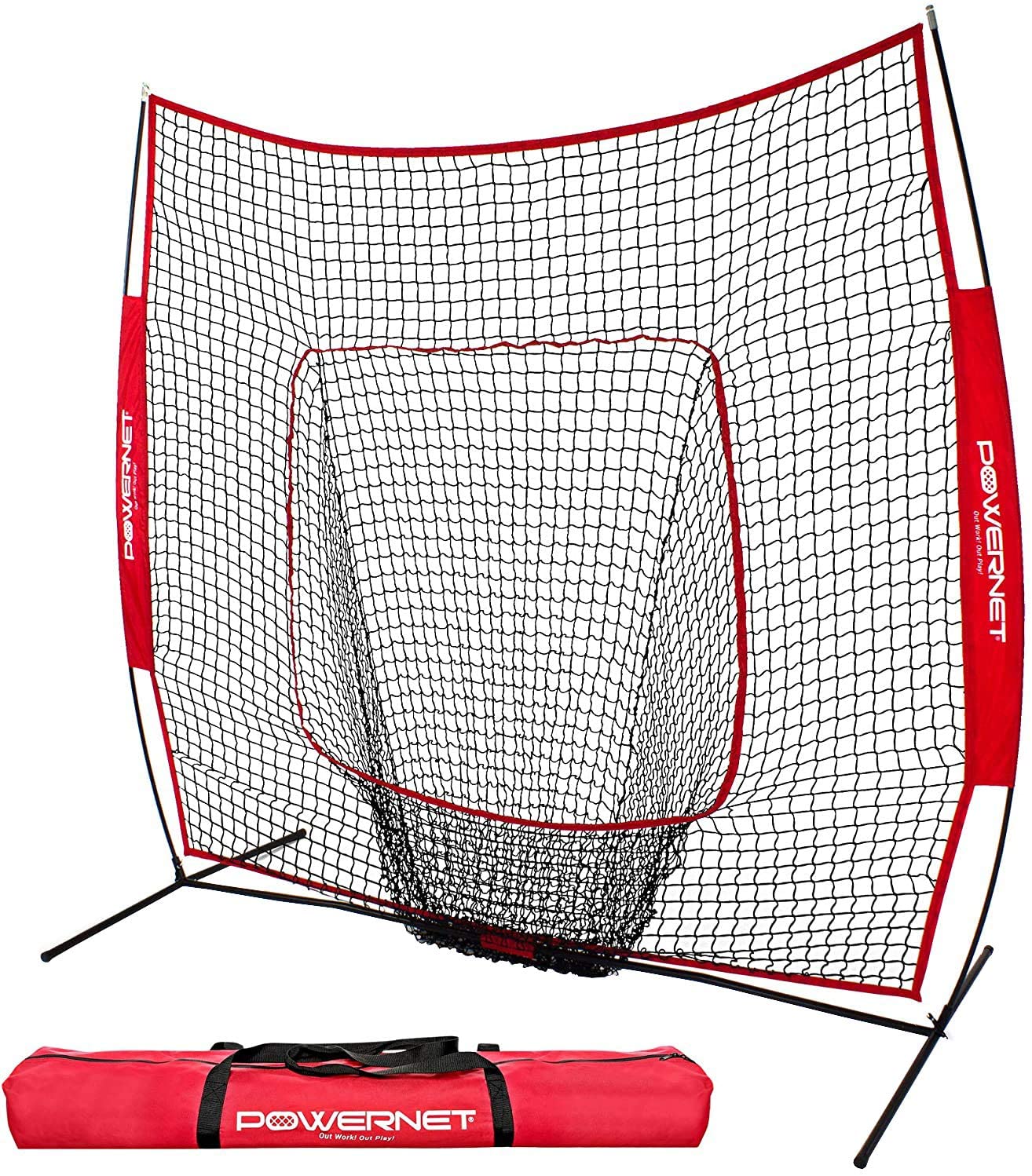
portable baseball nets for practice — Training aids require compact, portable practice setups; pop-up nets are a natural companion for solo swing training sessions mentioned in this article..
durable baseball bag for practice gear — The source discusses portable training equipment that requires storage and transport; a dedicated baseball bag is the natural companion for carrying and organizing swing trainers and practice tools..
scorebook to track training progress — Training aids require organized storage and transport; a scorebook complements practice sessions by allowing coaches to document and measure improvement over time..
Price: $40-$55
Best for: Solo practice with high repetition
Rawlings Pro-Grade Weighted Hitting Knob
Weighted bat accessories add resistance to your swing, which builds bat speed through overload training. The Rawlings Weighted Hitting Knob slides onto the handle of any bat and adds 12 or 16 ounces of weight concentrated at the knob end. This forces your hands to work harder through the swing path.
The key benefit is that you swing your actual game bat rather than a separate training bat, so the feel translates directly.
After removing the weight, your regular bat feels lighter and faster. Alternate between weighted and unweighted swings during batting practice for the best results.
basepath training equipment builds explosive speed — The swing trainer article discusses building bat speed and muscle memory; linking to basepath equipment naturally extends the conversation to how explosive lower-body development complements hitting mechanics..
Price: $20-$30
Best for: Building bat speed through overload training
Insider Bat
The Insider Bat is a short-barrel training bat designed to force hitters to use proper hand path and stay inside the ball.
The abbreviated barrel length means you cannot cast your hands or sweep the bat around. You have to take a direct, efficient path to the ball to make solid contact.
It works great for tee work, soft toss, and front toss. Many hitting coaches use it as a warm-up tool before regular batting practice. The compact size also makes it useful for indoor cage work where space is limited. Available in youth and adult sizes.
Price: $50-$70
Best for: Fixing casting and developing a short, direct swing path
SwingRail Swing Trainer
The SwingRail attaches to the forearm of the lead arm and creates a physical connection between your elbow and the bat during the swing.
This connection forces proper elbow position and prevents the common flaw of the lead arm flying open. When your mechanics break down, you feel it immediately through the trainer.
The device is adjustable for different arm sizes and works during regular batting practice with any bat. Many college programs use the SwingRail as part of their daily warm-up routine. It takes a few swings to get comfortable with the feel, but the mechanical feedback is immediate and clear.
Price: $60-$80
Best for: Correcting lead arm mechanics and maintaining connection
Rope Bat
The Rope Bat replaces the rigid barrel of a bat with a flexible rope. To generate any kind of whip through the hitting zone, you have to sequence your swing properly from the ground up through the hips, torso, and hands. A poorly sequenced swing makes the rope flop uselessly.
A well-sequenced swing creates an audible crack as the rope whips through the zone.
The auditory feedback is what makes this tool so effective. You know immediately whether your swing was sequenced correctly without needing any technology or coaching. It works great as a warm-up tool and for building rotational power.
Price: $90-$110
Best for: Developing proper swing sequencing and rotational power
Camwood Hands and Speed Training Bat
Camwood weighted training bats are used throughout professional baseball.
The one-hand training bat weighs 32 ounces and is designed for single-hand drills that build wrist strength, forearm endurance, and hand speed. The concentrated weight forces your hands to do the work rather than relying on body rotation alone.
Professional hitting coaches pair Camwood one-hand drills with regular swings to develop what they call strong, fast hands through the zone. The bat is not meant for hitting pitched balls.
Use it for dry swings, tee work, and specific drill sequences. The dense hardwood construction is built to last for years.
Price: $35-$50
Best for: Building hand and wrist strength for faster bat speed
SKLZ Cyclone Speed Trainer
The Cyclone is a compact, portable soft toss machine that feeds balls at a consistent pace without needing a partner.
It uses SKLZ training balls (included) and tosses them at a slight upward angle perfect for front toss drills. A simple dial controls the feed rate so you can work at your own pace.
It runs on batteries, sets up in seconds, and fits in an equipment bag. For players who practice alone frequently, the Cyclone eliminates the biggest obstacle to getting quality reps. The smaller training balls also work well for developing hand-eye coordination and bat control.
Price: $70-$90
Best for: Solo batting practice without a partner
How to Choose a Swing Trainer
Identify the specific problem first. Training aids work best when they target a specific mechanical issue.
Casting the hands? Try the Insider Bat. Poor sequencing? The Rope Bat gives instant feedback. Slow bat speed? Weighted training with the Camwood or hitting knob addresses that directly. Buying a random training aid without knowing your weakness is a waste of money.
Simple tools often work best. The fanciest technology is not always the most effective. A heavy bat, a tee, and 200 focused swings will do more for most hitters than an expensive gadget used casually.
Whatever tool you buy, commit to using it consistently.
Match the tool to the age. Young players benefit most from repetition tools like the Hit-A-Way and basic tee work. Advanced mechanics tools like the SwingRail and Rope Bat work better for high school and older players who already have a baseline swing to refine.
Budget for consistent use. A $40 tool you use every day beats a $200 tool that sits in the garage.
Start with one training aid, use it until you see improvement, then add another targeting a different weakness.
Final Thoughts
For data-minded players, the Blast Motion Swing Analyzer provides the most comprehensive feedback available. For pure repetition, the SKLZ Hit-A-Way is hard to beat for value and simplicity. The Rope Bat is the best tool for teaching proper swing sequencing, and the Camwood one-hand bat builds the hand strength that translates directly to bat speed.
Pick the tool that addresses your biggest weakness and commit to using it daily.